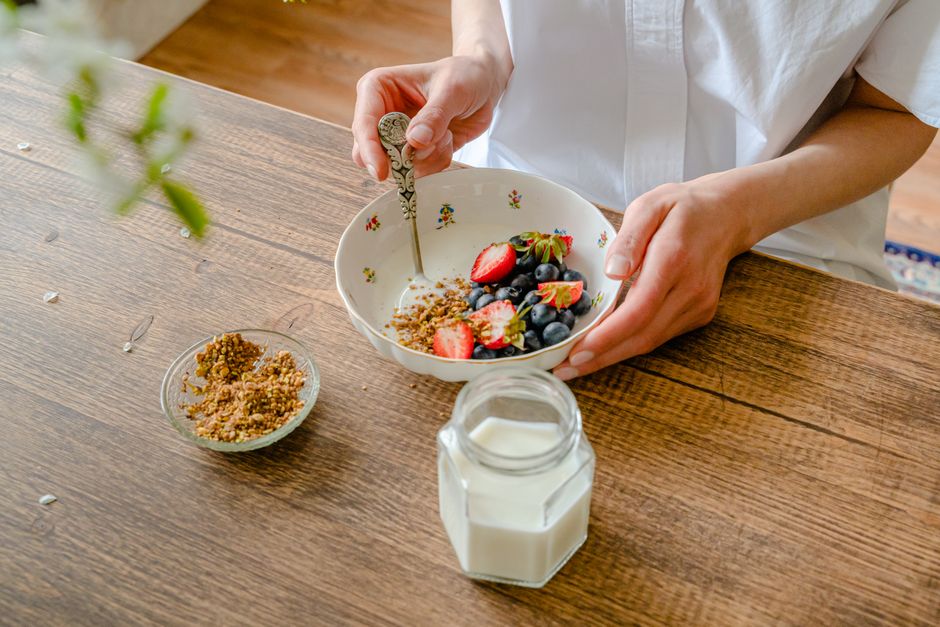
High-protein eating for weight loss: why protein helps fullness and muscle, the ranges studies used, food sources with USDA numbers and the kidney caution.
Key facts
- Evidence
- Moderate
- Difficulty
- Moderate
- Sustainability
- Easier to sustain
- Goals
- Control appetite, Lose a little weight, Preserve muscle
Key takeaways
- With the same calories, high-protein diets gave slightly more weight and fat loss and kept 0.43 kg more lean mass in pooled trials.[1]
- Weight-loss studies have mostly used 1.2 to 1.6 g of protein per kg a day, with about 25 to 30 g at meals.[2]
- In healthy adults, higher-protein diets did not change kidney function in a meta-analysis of 28 trials.[6]
- People with chronic kidney disease may need moderate protein and should set amounts with a dietitian or clinician.[7]
In short: A high-protein diet for weight loss means getting a larger share of your calories from protein foods while eating a little less overall. In trials it led to modestly more weight and fat loss than standard-protein diets with the same calories, helped people keep more muscle and was a bit more filling. Research on weight loss has mostly studied about 1.2 to 1.6 grams of protein per kilogram of body weight a day; people with kidney disease need personal advice before eating more protein.
This page explains why protein helps during weight loss, the ranges research has studied, the best food sources with real numbers, the kidney caution and how to build a high-protein day. It is general information, not a personal target: use our protein calculator for a range and talk to a clinician or dietitian if you have a health condition. For other approaches, visit the diets hub.
Why protein helps: fullness and muscle
Muscle. When you lose weight, some of what you lose is lean tissue, including muscle. A 2012 meta-analysis in the American Journal of Clinical Nutrition pooled 24 trials (1,063 people) that compared high-protein and standard-protein diets with the same calories and fat. The high-protein diets led to a little more weight loss (0.79 kg more) and fat loss (0.87 kg more), protected more fat-free mass (0.43 kg) and limited the drop in resting energy use. Keeping muscle matters for strength, daily function and for keeping weight off later.
Fullness. A 2015 review in the same journal found a modest satiety effect from higher-protein meals: people reported feeling fuller and had higher levels of satiety hormones. The same review noted that longer studies are mixed, mostly because many people do not stick to the higher-protein plan, and those who did saw the benefit.
Protein works best alongside strength training. Our strength training guide explains why lifting, even with light weights or body weight, helps you keep muscle while losing fat, and our body recomposition guide covers losing fat and gaining muscle at the same time.
How much protein: the ranges research has studied
MedlinePlus, from the National Library of Medicine, gives the general range for healthy adults as 10% to 35% of daily calories from protein. Weight-loss research usually expresses protein per kilogram of body weight. The 2015 review concluded that diets with between 1.2 and 1.6 grams of protein per kilogram a day, with at least about 25 to 30 grams at meals, improved appetite, weight management or heart-risk factors in studies. For people who exercise, the International Society of Sports Nutrition considers 1.4 to 2.0 grams per kilogram a day sufficient for most to build and keep muscle.
Protein ranges by situation
- 10-35%of daily calories from protein: the general range for healthy adultsMedlinePlus
- 1.2-1.6 g/kga day: the range used in weight-loss studiesLeidy HJ et al., AJCN 2015
- 25-30 gof protein at meals in those studiesLeidy HJ et al., AJCN 2015
- 1.4-2.0 g/kga day: sufficient for most people who exerciseISSN position stand 2017
Checked on October 6, 2026
Evidence rating (InstaTuck)Moderate
These are ranges from studies, not a prescription. Your own target depends on your size, age, activity, kidney health and the rest of your diet. The protein calculator turns a range into grams for you, and the macro calculator shows how protein fits with carbohydrate and fat.
Food sources: protein per portion
Values below come from the USDA FoodData Central database (SR Legacy), rounded, checked on 2026-10-06. Plant foods bring fiber along with protein, which helps with fullness too.
| Food | Portion | Protein (g) | Calories |
|---|---|---|---|
| Chicken breast, roasted, no skin | 3 oz (85 g) | 26 | 140 |
| Ground beef 93% lean, broiled | 3 oz (85 g) | 22 | 165 |
| Firm tofu (calcium-set) | 1/2 cup (126 g) | 22 | 180 |
| Shrimp, cooked | 3 oz (85 g) | 20 | 85 |
| Cod, cooked | 3 oz (85 g) | 19 | 90 |
| Atlantic salmon, farmed, cooked | 3 oz (85 g) | 19 | 175 |
| Lentils, boiled | 1 cup (198 g) | 18 | 230 |
| Plain nonfat Greek yogurt | 1 container (170 g) | 17 | 100 |
| Light tuna, canned in water | 3 oz (85 g) | 17 | 75 |
| Black beans, boiled | 1 cup (172 g) | 15 | 225 |
| Low-fat (1%) cottage cheese | 1/2 cup (113 g) | 14 | 80 |
| Edamame, cooked | 1/2 cup (78 g) | 9 | 95 |
| Egg, hard-boiled | 1 large (50 g) | 6 | 80 |
Protein shakes and bars can fill gaps when time is short; our guide to protein shakes for weight loss explains when they help and what to check on the label. For more ideas, see our healthy snacks list, sorted by calories and protein, and our high-protein smoothie recipe.
Kidney caution
For healthy adults, a 2018 meta-analysis in the Journal of Nutrition (28 trials, 1,358 people without kidney disease) found that higher-protein diets did not harm kidney function, measured as changes in filtration rate. The picture is different for people who already have chronic kidney disease. The NIDDK explains that protein breaks down into waste the kidneys must clear, and that people with kidney disease may need moderate amounts of protein; it advises working with a dietitian or health care professional to find the right amount and sources. If you have kidney disease, diabetes with kidney involvement or reduced kidney function on a blood test, do not raise protein without that advice.
Building a high-protein day
- Anchor every meal with a protein food: eggs or Greek yogurt at breakfast, fish, chicken, tofu or beans at lunch and dinner.
- Spread it out rather than eating most of your protein at dinner; the 2015 review highlights meal-sized amounts.
- Choose lean and plant options often, so calories and saturated fat stay in check.
- Keep vegetables, fruit and whole grains on the plate; a high-protein diet is not a no-carb diet.
- Pair it with strength training two or more days a week, as the U.S. Physical Activity Guidelines recommend for all adults.
Difficulty, sustainability and cost
Eating more protein is moderately easy for most people because it fits with almost any eating style, including Mediterranean, DASH and plant-based. The cost depends on the sources: eggs, canned tuna, dried beans, lentils, tofu and Greek yogurt are budget-friendly, while fresh fish and lean cuts of meat cost more. The main challenge is consistency, which is where planning meals ahead helps; see our meal prep guide.
Protein during medical weight loss
Protein gets extra attention for people taking GLP-1 medicines, who often eat much less. A 2025 joint advisory from four obesity and nutrition societies lists preserving muscle and bone through resistance training and appropriate diet among the priorities during GLP-1 treatment. Our guides to eating on a GLP-1 and muscle loss on GLP-1s cover this in detail.
The approach
A modest calorie deficit with a larger share of calories from protein foods at every meal, plus vegetables, fruit and whole grains. Research on weight loss has mostly studied about 1.2 to 1.6 g of protein per kg of body weight a day.
What the evidence shows
A meta-analysis of 24 trials (1,063 people) found that isocaloric high-protein diets gave 0.79 kg more weight loss and 0.87 kg more fat loss than standard-protein diets, preserved 0.43 kg more fat-free mass and limited the fall in resting energy use. Acute studies show a modest satiety effect; longer trials are mixed, largely because of adherence.
Foods
Emphasized
- Poultry, fish and seafood
- Eggs
- Greek yogurt, cottage cheese and milk
- Tofu, tempeh and edamame
- Beans, lentils and chickpeas
- Lean cuts of meat
- Vegetables, fruit and whole grains alongside
Limited
- Processed meats such as bacon and sausages
- Fatty cuts of meat in large portions
- Protein bars and snacks with a lot of added sugar
- Sugary drinks
Protein
Studies of weight loss have mostly used 1.2-1.6 g/kg/day, with about 25-30 g at meals; the ISSN considers 1.4-2.0 g/kg/day sufficient for most people who exercise. These are study ranges, not a personal target; the protein calculator turns them into grams.
Scorecard
- Evidence
- Moderate
- Invasiveness
- None
- Medical supervision
- None
- Convenience
- Simple
- Cost
- $$
- Maintenance
- Low
No overall score: each dimension stands on its own. Hover a value for its definition.
Advantages and limitations
Advantages
- Slightly more weight and fat loss than standard-protein diets with the same calories
- Helps keep muscle (fat-free mass) during weight loss
- Modestly more filling meals
- Fits with Mediterranean, DASH and plant-based eating
Limitations
- Not suitable without advice for people with chronic kidney disease
- Benefits depend on sticking with it, which long-term trials found hard
- Fresh fish and lean meat can be costly
- Some protein snacks are highly processed
Check with a clinician first if
- People with chronic kidney disease or reduced kidney function
- People with diabetes who have kidney involvement
- People with a history of eating disorders, for whom rigid food rules can be harmful
- People who are pregnant, for whom a dietitian can set needs
A starter week
| Day | Meals |
|---|---|
| Monday | Greek yogurt with berries; chicken, chickpea and vegetable salad; salmon, roasted vegetables and quinoa. Snack: cottage cheese and fruit. |
| Tuesday | Two eggs with whole-grain toast and tomatoes; lentil soup with a side salad; tofu and vegetable stir-fry with brown rice. |
| Wednesday | High-protein smoothie (milk or soymilk, Greek yogurt, fruit); tuna and white bean wrap; turkey chili with beans. |
| Thursday | Cottage cheese with pineapple; leftover chili; baked cod, potatoes and green beans. |
| Friday | Vegetable omelet; chicken and black bean bowl with salsa; shrimp, vegetables and whole-wheat pasta. |
| Saturday | Greek yogurt parfait with pumpkin seeds; edamame and grain salad; lean beef or bean burgers with a large salad. |
| Sunday | Eggs and fruit; leftover grain salad with grilled chicken; roast chicken, vegetables and a baked sweet potato. |
Similar diets
 Mediterranean Diet for Weight Loss: foods, evidence and a 7-day starterEvidence: High · Easy
 DASH Diet: lower blood pressure and weight togetherEvidence: High · Moderate
 Keto Diet: how it works, risks and who it suitsEvidence: Moderate · Hard
 Intermittent Fasting: 16:8, 5:2 and what the evidence showsEvidence: Moderate · Moderate
Research mentioning it
 10 Best Strength Moves to Protect Muscle While Losing WeightThe 10 best strength moves to protect muscle while losing weight, ranked by energy cost and…
 10 Best Protein Bars (Highest Protein per Calorie)Ten protein bars ranked by third-party certification, protein per calorie, sugar and sugar alcohols, and price…
 10 Best High-Protein Packaged SnacksTen high-protein packaged snacks ranked by how filling they are for their calories, with maker-stated protein,…
Related guides
 Body Recomposition: lose fat and build muscle at the same timeBody recomposition explained: how to lose fat and build muscle at the same time, who sees…
 Muscle Loss on GLP-1s: protein, strength training and what studies showMuscle loss on GLP-1 medicines: what DXA studies found, lean mass vs muscle, who is at…
Tools for this topic

Questions to ask a professional
- What daily protein range is safe for me, given my kidney function and health history?
- Should we check my kidney function before I increase protein?
- How can I spread protein across meals in a way that fits my budget and culture?
- Would a registered dietitian help me plan a high-protein, lower-calorie diet?
- If I take a GLP-1 medicine, how should I protect my muscle while my appetite is low?
Frequently asked questions
How much protein should I eat to lose weight?
Studies of weight loss have mostly used about 1.2 to 1.6 grams per kilogram of body weight a day. Your own target depends on your size, activity and health, especially kidney health. Our protein calculator gives a range, and a clinician or dietitian can personalize it.
Is a high-protein diet bad for your kidneys?
In healthy adults, a meta-analysis of 28 trials found no adverse effect on kidney function. People who already have kidney disease are different and should set protein with their care team.
Can I get enough protein without meat?
Yes. Greek yogurt, cottage cheese, eggs, tofu, edamame, lentils and beans are all good sources, and plant sources add fiber. Spreading them across meals helps.
Do I need protein shakes?
No, food works well. Shakes can be convenient when time is short or appetite is low. Our protein shakes guide explains what to check on the label.
Does protein help me keep muscle while losing weight?
Yes, in pooled trials higher-protein diets preserved more fat-free mass than standard-protein diets with the same calories. Combining protein with strength training helps most.
References
- Wycherley TP, Moran LJ, Clifton PM, Noakes M, Brinkworth GD. Effects of energy-restricted high-protein, low-fat compared with standard-protein, low-fat diets: a meta-analysis of randomized controlled trials. American Journal of Clinical Nutrition, 2012. doi:10.3945/ajcn.112.044321 · PMID 23097268 (accessed October 7, 2026) Meta-analysis
- Leidy HJ, Clifton PM, Astrup A, et al.. The role of protein in weight loss and maintenance. American Journal of Clinical Nutrition, 2015. doi:10.3945/ajcn.114.084038 · PMID 25926512 (accessed October 7, 2026) Review
- Protein in diet. MedlinePlus, National Library of Medicine. (accessed October 6, 2026) Government page
- Jäger R, Kerksick CM, Campbell BI, et al.. International Society of Sports Nutrition Position Stand: protein and exercise. Journal of the International Society of Sports Nutrition, 2017. doi:10.1186/s12970-017-0177-8 · PMID 28642676 (accessed October 6, 2026) Society statement
- FoodData Central (SR Legacy, April 2018 release). U.S. Department of Agriculture, Agricultural Research Service, 2018. (accessed October 7, 2026) Government page
- Devries MC, Sithamparapillai A, Brimble KS, et al.. Changes in Kidney Function Do Not Differ between Healthy Adults Consuming Higher- Compared with Lower- or Normal-Protein Diets: A Systematic Review and Meta-Analysis. Journal of Nutrition, 2018. doi:10.1093/jn/nxy197 · PMID 30383278 (accessed October 7, 2026) Meta-analysis
- Eating Right for Chronic Kidney Disease. National Institute of Diabetes and Digestive and Kidney Diseases (NIH). (accessed October 6, 2026) Government page
- Physical Activity Guidelines for Americans, 2nd edition: top 10 things to know. U.S. Department of Health and Human Services (ODPHP). (accessed October 7, 2026) Guideline
- Mozaffarian D, Agarwal M, Aggarwal M, et al.. Nutritional priorities to support GLP-1 therapy for obesity: a joint Advisory from the American College of Lifestyle Medicine, the American Society for Nutrition, the Obesity Medicine Association, and The Obesity Society. American Journal of Clinical Nutrition, 2025. doi:10.1016/j.ajcnut.2025.04.023 · PMID 40450457 (accessed October 6, 2026) Society statement
Facts checked on October 6, 2026
Educational information, not medical advice. Talk with a qualified healthcare professional about your own situation. In an emergency call 911.