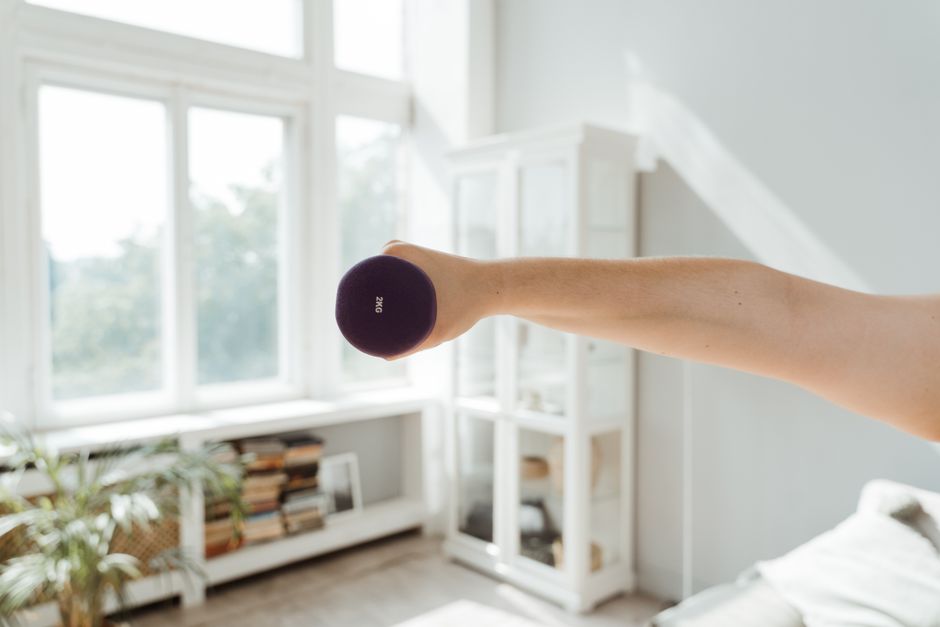
Strength training for weight loss: why muscle matters (also on GLP-1s), MET values, a beginner plan for home or gym, protein, progression and safety.
Key facts
- Intensity
- Moderate
- Impact
- Low impact
- MET range
- 3.0-6.5
- Main muscles
- Whole body: legs and glutes (squat, hinge), chest, shoulders and arms (push), back (pull) and core.
- Equipment
- None to start (body weight and a sturdy chair), Resistance bands, Adjustable or fixed dumbbells, Optional: gym machines, kettlebell, exercise mat
Key takeaways
- Adults should do muscle-strengthening activity for all major muscle groups on 2 or more days a week.[1]
- Resistance training reduced lean mass loss during weight loss by about 0.8 kg in pooled studies.[2]
- Beginners: 2 to 3 days a week, loads you can lift 8 to 12 times, larger muscle groups first.[4]
- Four societies advise resistance training and appropriate diet to protect muscle and bone during GLP-1 treatment.[6]
This article contains affiliate links: if you buy through them we may earn a commission, at no extra cost to you. Learn more.
In short: Strength training does not burn a huge number of calories, but it changes what you lose: in pooled studies, resistance training during weight loss reduced the loss of lean mass, so more of the weight that comes off is fat. U.S. guidelines recommend muscle-strengthening activity for all major muscle groups on 2 or more days a week. Beginners can start with body weight, bands or light dumbbells, 2 to 3 sessions a week, and build up gradually.
This page explains why muscle matters when you lose weight (including on GLP-1 medicines), gives a beginner plan you can do at home or in a gym, and covers protein, progression and safety. It is general information; if you have a heart condition, high blood pressure, joint problems or recent surgery, ask your clinician or a physical therapist how to start. For other activities, visit our exercise hub.
At a glance
- 2+ daysa week of muscle-strengthening for all major muscle groupsODPHP Physical Activity Guidelines
- 0.8 kgless lean mass lost during weight loss with resistance training (pooled studies)Bellicha et al., Obesity Reviews 2021
- 8-12 repsbeginner load range, 2-3 days a weekACSM Progression Models position stand 2009
Checked on October 6, 2026
Why muscle matters when you lose weight
When you eat less to lose weight, your body loses some lean tissue along with fat. A 2021 overview in Obesity Reviews, covering 12 systematic reviews and 149 studies, found that resistance training reduced lean mass loss during weight loss by about 0.8 kg compared with not training. The American College of Sports Medicine notes that resistance training does not add much to weight loss itself, but it can increase fat-free mass and fat loss. Keeping muscle helps you stay strong for everyday tasks; our guide to metabolism and weight explains what you can and cannot change.
Age adds to the case. The National Institute on Aging explains that muscle mass and strength decline from midlife and that strength training helps older adults keep muscle. See our guide to losing weight after 40 for more.
On a GLP-1 medicine
GLP-1 medicines such as semaglutide and tirzepatide can lead to large weight losses, and part of that loss can be muscle and bone. A 2025 joint advisory from the American College of Lifestyle Medicine, the American Society for Nutrition, the Obesity Medicine Association and The Obesity Society lists muscle and bone loss among the challenges of GLP-1 treatment and recommends preserving them through resistance training and an appropriate diet, along with checking strength and body composition. Our guide to muscle loss on GLP-1s covers what studies show, and preserving muscle while losing weight brings the strategies together.
How hard is strength training? MET values
| Activity | MET | Compendium code |
|---|---|---|
| Body-weight exercises (squat, lunge, push-up, crunch), general | 3.0 | 02056 |
| Weight training, multiple exercises, 8 to 15 reps at varied resistance | 3.5 | 02054 |
| Calisthenics (push-ups, sit-ups, lunges), moderate effort | 3.8 | 02022 |
| Circuit training, moderate effort | 5.0 | 02035 |
| Weight lifting or body building, vigorous effort | 6.0 | 02050 |
| Body-weight exercises, high intensity | 6.5 | 02057 |
A typical beginner session is around 3.5 METs, similar to a moderate walk, so the calories used during the session are modest. The value of strength training for weight loss is the muscle you keep, not the calories on the display. Our calories burned calculator gives an estimate for your weight.
A beginner plan
The American College of Sports Medicine’s position on resistance training recommends that beginners train 2 to 3 days a week with loads they can lift for 8 to 12 repetitions, putting larger-muscle and multi-joint exercises first. The plan in the box below follows that. Each session covers the whole body with five movements:
- Squat (to a chair at first) or leg press.
- Push: wall or incline push-up, or chest press.
- Hip hinge: glute bridge, or a light dumbbell deadlift once you have learned the movement.
- Pull: band row or dumbbell row.
- Core: plank or dead bug.
Start with one set of 8 to 12 repetitions of each, with a weight or variation that feels challenging by the last few reps but lets you keep good form. Rest a minute or two between exercises. Over the weeks, add a second and third set.
Home vs gym
Both work. At home, body weight, a set of resistance bands and a pair of adjustable dumbbells cover every movement in the plan, with no commute and no audience. A gym adds machines that guide the movement, heavier weights for later, and often staff who can check your form; many people like a few sessions with a trainer at the start. Two widely sold home options, with specifications as stated by the makers:
Fit Simplify Resistance Loop Exercise Bands, Set of 5
- 5 color-coded resistance levels (maker-stated)
- 12 x 2 in loop bands, natural latex
- Instruction guide and carry bag
- Not for people with a latex allergy
NordicTrack 55 lb Select-a-Weight Dumbbell Pair
- Adjusts in 2.5, 5 and 10 lb increments (maker-stated)
- 10 lb handles, up to 55 lb each
- Replaces 15 pairs of fixed dumbbells
- Storage trays included
Protein: the other half
Training gives muscle a reason to stay; protein gives it the material. In a meta-analysis of 24 trials, higher-protein diets with the same calories preserved more fat-free mass during weight loss than standard-protein diets. Our high-protein diet guide lists food sources with numbers, and the protein calculator gives a daily range.
Progression: how to keep improving
Muscles adapt to what you ask of them, so the plan needs to grow. The ACSM suggests increasing the load by about 2% to 10% once you can do one or two more repetitions than your target with good form. You can also progress by adding a set, slowing the lowering phase, or moving to a harder variation (wall push-up, then incline, then floor). Track what you lift so you can see progress that the scale may not show; our body recomposition guide explains how to measure it.
How to progress
- Learn the movementBody weight or a light load, good form first.
- One set of 8 to 12A weight that feels challenging by the last few reps, 2 to 3 days a week.
- Add setsBuild to a second and then a third set over the weeks.
- Add loadOnce you can do 1 or 2 reps more than your target, increase the load by about 2% to 10%.
- Harder variationsWall push-up, then incline, then floor; slow the lowering phase.
Safety
- Learn the movement before adding weight. Good form matters more than load.
- Breathe: exhale as you push or lift; avoid holding your breath.
- Muscle soreness for a day or two is normal when you start; sharp or joint pain is not. Stop and get advice.
- Leave a day between sessions for the same muscles.
- Ask your clinician first if you have heart disease, uncontrolled blood pressure, recent surgery, osteoporosis or a joint injury.
Pair your strength sessions with regular walking on the other days to meet the aerobic guideline, and see our how to lose weight guide for the full plan.
Energy cost (MET values)
| Activity | MET | Compendium code |
|---|---|---|
| Body-weight resistance exercises (squat, lunge, push-up, crunch), general | 3.0 | 02056 2024 Adult Compendium |
| Resistance (weight) training, multiple exercises, 8-15 reps at varied resistance | 3.5 | 02054 2024 Adult Compendium |
| Calisthenics (push-ups, sit-ups, pull-ups, lunges), moderate effort | 3.8 | 02022 2024 Adult Compendium |
| Circuit training, moderate effort | 5.0 | 02035 2024 Adult Compendium |
| Resistance (weight lifting), power lifting or body building, vigorous effort | 6.0 | 02050 2024 Adult Compendium |
| Body-weight resistance exercises, high intensity | 6.5 | 02057 2024 Adult Compendium |
MET values from the Compendium of Physical Activities. Calories burned depend on body size and effort.
A beginner plan
| Week | Sessions | Minutes | Note |
|---|---|---|---|
| 1 | 2 | 20 | Learn the five movements with body weight or very light resistance; 1 set of 8-12 reps each. |
| 2 | 2 | 25 | 1 set of 8-12 reps; pick a load that feels challenging by the last few reps. |
| 3 | 3 | 25 | Add a third weekly session with a rest day between sessions. |
| 4 | 3 | 30 | 2 sets of each exercise. |
| 5 | 3 | 35 | When you can do 1-2 reps more than the target, raise the load by about 2-10%. |
| 6 | 3 | 40 | 2-3 sets; try a harder variation of one exercise (for example incline to floor push-up). |
Cautions
- Ask your clinician first with heart disease, uncontrolled high blood pressure, recent surgery, osteoporosis or a joint injury.
- Exhale on the effort and avoid holding your breath.
- Stop for sharp or joint pain, chest pain, dizziness or unusual shortness of breath.
- Resistance bands are often latex: check if you have a latex allergy.
Similar activities

Research mentioning it
 Brown Fat, Cold Plunges and Saunas: Do They Help Weight Loss?Do cold plunges, brown fat and saunas help weight loss? What human studies show: brown fat…
 10 Best Strength Moves to Protect Muscle While Losing WeightThe 10 best strength moves to protect muscle while losing weight, ranked by energy cost and…
 10 Best Kettlebells (and How to Start)10 kettlebells researched for home training: cast iron, competition and adjustable, with maker-stated weights, prices and…
Related guides
 Body Recomposition: lose fat and build muscle at the same timeBody recomposition explained: how to lose fat and build muscle at the same time, who sees…
 Muscle Loss on GLP-1s: protein, strength training and what studies showMuscle loss on GLP-1 medicines: what DXA studies found, lean mass vs muscle, who is at…
Tools for this topic
 Protein Calculator: how much protein per dayFree protein calculator: grams of protein per day for weight loss, strength training, older age and…
 Calories Burned Calculator for 100+ activitiesFree calories burned calculator for 100+ activities using 2024 Compendium MET values, with examples, walking pad…
Questions to ask a professional
- Is strength training safe for me with my heart, blood pressure, bone or joint health?
- Are there movements I should avoid or adapt?
- If I take a GLP-1 medicine, should we check my strength or body composition?
- How much protein do I need while I train and lose weight?
- Would a few sessions with a physical therapist or trainer help me start safely?
Frequently asked questions
Is strength training or cardio better for weight loss?
Aerobic activity like walking uses more energy per session, while strength training helps you keep muscle so more of the weight you lose is fat. Guidelines recommend both: aerobic minutes most days and strength work on 2 or more days.
How often should beginners lift weights?
The ACSM recommends 2 to 3 days a week for beginners. Many people leave a rest day between sessions that work the same muscles.
Will lifting weights make me bulky?
During weight loss, strength training mainly helps you keep the muscle you have; in pooled studies it reduced lean mass loss rather than adding bulk.
Can I strength train at home without equipment?
Yes. Squats to a chair, incline push-ups, glute bridges, planks and rows with a band cover the whole body. Add bands or dumbbells as you get stronger.
Why does the scale not move when I start lifting?
The calories used in a strength session are modest, and the main benefit is the muscle you keep. Track strength, waist size and how clothes fit along with weight.
References
- Physical Activity Guidelines for Americans, 2nd edition: top 10 things to know. U.S. Department of Health and Human Services (ODPHP). (accessed October 7, 2026) Guideline
- Bellicha A, van Baak MA, Battista F, et al.. Effect of exercise training on weight loss, body composition changes, and weight maintenance in adults with overweight or obesity: An overview of 12 systematic reviews and 149 studies. Obesity Reviews, 2021. doi:10.1111/obr.13256 · PMID 33955140 (accessed October 7, 2026) Review
- Donnelly JE, Blair SN, Jakicic JM, et al.. American College of Sports Medicine Position Stand: Appropriate physical activity intervention strategies for weight loss and prevention of weight regain for adults. Medicine & Science in Sports & Exercise, 2009. doi:10.1249/MSS.0b013e3181949333 · PMID 19127177 (accessed October 7, 2026) Society statement
- American College of Sports Medicine. American College of Sports Medicine position stand. Progression models in resistance training for healthy adults. Medicine & Science in Sports & Exercise, 2009. doi:10.1249/MSS.0b013e3181915670 · PMID 19204579 (accessed October 7, 2026) Society statement
- How can strength training build healthier bodies as we age?. National Institute on Aging (NIH). (accessed October 6, 2026) Government page
- Mozaffarian D, Agarwal M, Aggarwal M, et al.. Nutritional priorities to support GLP-1 therapy for obesity: a joint Advisory from the American College of Lifestyle Medicine, the American Society for Nutrition, the Obesity Medicine Association, and The Obesity Society. American Journal of Clinical Nutrition, 2025. doi:10.1016/j.ajcnut.2025.04.023 · PMID 40450457 (accessed October 6, 2026) Society statement
- 2024 Adult Compendium (activity lists and PDF). Compendium of Physical Activities, 2024. (accessed October 7, 2026) Other
- Wycherley TP, Moran LJ, Clifton PM, Noakes M, Brinkworth GD. Effects of energy-restricted high-protein, low-fat compared with standard-protein, low-fat diets: a meta-analysis of randomized controlled trials. American Journal of Clinical Nutrition, 2012. doi:10.3945/ajcn.112.044321 · PMID 23097268 (accessed October 7, 2026) Meta-analysis
Facts checked on October 6, 2026
Educational information, not medical advice. Talk with a qualified healthcare professional about your own situation. In an emergency call 911.