Best picks
The 10 best core exercises for strength, ranked by energy cost, muscle activity and joint load, with form cues, a 15-minute plan and why ab work does not burn belly fat.
Key takeaways
- In a lab study, the roll-out reached 63% of maximum activity in the upper abs and the pike 84% in the external obliques, more than most other ab moves.[3]
- Ground-based lifts such as squats and deadlifts can activate the core as much as or more than exercises on unstable surfaces.[6]
- Six weeks of ab exercises 5 days a week improved ab endurance but changed no measure of belly fat.[8]
- Most core moves sit at 2.8 to 3.8 METs in the 2024 Compendium; mountain climbers in vigorous intervals are rated 11.0.[1]
In short: The core exercises worth your time are the ones that make your trunk work hard while it holds steady: mountain climbers (the biggest calorie burn, 11.0 METs in hard intervals), goblet squats and deadlifts (core work while your legs and back get stronger) and roll-outs (the highest abdominal muscle activity in lab tests). Side planks, bird dogs and planks round out a strong, back-friendly routine. None of them burns belly fat from that spot: a 6-week trial of daily ab exercises changed no measure of belly fat at all.
A strong core helps you lift, carry, twist and stay steady on your feet. That is reason enough to train it. What it won’t do is flatten your stomach by itself, so this list is about strength, posture and comfort, not “ab burn”. If belly fat is your main worry, start with our guide to getting a flatter stomach and the research behind the spot reduction myth, then come back here for the moves. If you have back pain, a hernia, are pregnant or recently gave birth, ask your clinician or a physical therapist which core moves suit you.
How we ordered them
All our exercise lists use the same order: energy cost first (from the 2024 Adult Compendium of Physical Activities), then muscle and strength benefit, then joint load and accessibility, then equipment. For core work we had to adapt it honestly. The Compendium does not rate core moves one by one: planks, curl-ups and crunches sit together at 2.8 METs, exercise-ball work at 2.8, sit-ups with other moderate calisthenics at 3.8, and floor back exercises at 3.5. That spread is worth only about 1 calorie a minute for a 150-pound person, so energy cost can’t separate most core moves.
So energy cost decides only the top of the list: the two moves that work the whole body and burn clearly more (mountain climbers in intervals at 11.0 METs, weighted squats and deadlifts at 5.0), plus loaded carries, which have no Compendium code but are whole-body loaded work like the lifts. Everything else is ordered by muscle and strength benefit, using lab studies that measured muscle activity (EMG, as a percentage of each person’s maximum contraction), then by how kind each move is to your back and joints, then by equipment.
The 10 best core exercises
10 core exercises for strength, ranked
1. Mountain climbers
Best for Core work with a real cardio burn
- 11.0 METs in vigorous intervals
- about 374 kcal per 30 min at 150 lb, 499 at 200 lb (work-interval rate)
- core, shoulders and hip flexors
Maker-stated specs
Price Free (body weight) (checked Oct 7, 2026)
Drawback Hard on wrists and very tiring; start with hands on a bench or counter
2. Goblet squat or dumbbell deadlift
Best for Training your core while legs and back get stronger
- 5.0 METs for weighted squats and deadlifts
- about 170 kcal per 30 min at 150 lb
- ground-based lifts match or beat unstable moves for core activation (CSEP)
Maker-stated specs
Price Free with a backpack; a dumbbell or kettlebell helps (checked Oct 7, 2026)
Drawback Needs good form; learn the hip hinge with light weight first
3. Farmer's and suitcase carries
Best for Grip, posture and a steady trunk for daily life
- Walk while holding weights at your sides (farmer's) or in one hand (suitcase)
- NSCA lists carries for core strength and control
- no separate Compendium code
Maker-stated specs
Price Free with shopping bags; dumbbells or kettlebells help (checked Oct 7, 2026)
Drawback Grip tires before the core; set the weights down before your posture slips
4. Roll-out (ab wheel or exercise ball)
Best for The strongest abdominal challenge for intermediate exercisers
- Highest abdominal EMG in a 10-exercise lab study: upper abs 63%, lower abs 53%, both obliques 46% of maximum
- 2.8 METs as exercise-ball work
Maker-stated specs
Price Exercise ball or ab wheel (checked Oct 7, 2026)
Drawback Can strain the lower back if your hips sag; start kneeling and roll out only a little
5. Exercise-ball pike or knee tuck
Best for Advanced obliques and lower-ab work
- Pike: external obliques 84%, lower abs 55%, internal obliques 56% of maximum in the same study
- 2.8 METs as exercise-ball work
Maker-stated specs
Price Exercise ball (checked Oct 7, 2026)
Drawback Balance-heavy and advanced; master the plank first
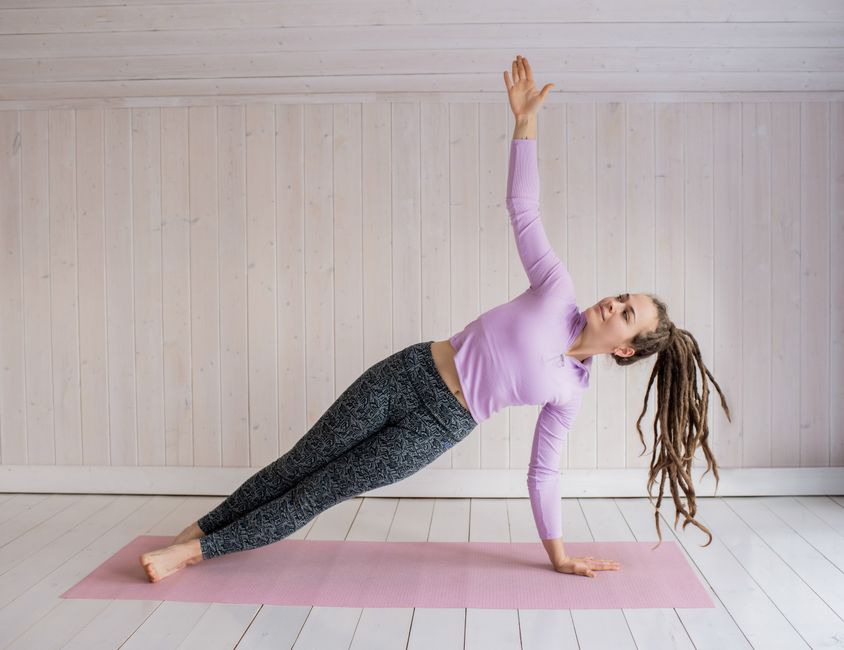
6. Side plank
Best for Obliques, side hips and a back-friendly core
- Side bridge reached strengthening-level activity for the external obliques and gluteus medius
- 2.8 METs as light calisthenics
Maker-stated specs
Price Free (a mat helps) (checked Oct 7, 2026)
Drawback Loads the bottom shoulder; do it from the knees to start
7. Plank (including the long-lever version)
Best for Building trunk endurance with no movement of the spine
- A long-lever, pelvis-tucked plank raised abdominal activity over a standard plank
- 2.8 METs as light calisthenics
Maker-stated specs
Price Free (a mat helps) (checked Oct 7, 2026)
Drawback Gets boring; longer holds add little, so make it harder instead
8. Bird dog
Best for Beginners and anyone with a cranky lower back
- Opposite arm and leg reach from hands and knees
- may help strengthen the glutes
- 3.5 METs as floor back exercises
Maker-stated specs
Price Free (a mat helps) (checked Oct 7, 2026)
Drawback Easy to rush; slow, steady reps matter more than count
9. Glute bridge
Best for Hips and lower back with very little joint load
- Lab activity for bridges stayed below the strengthening level, so they suit endurance and control
- no separate Compendium code
Maker-stated specs
Price Free (a mat helps) (checked Oct 7, 2026)
Drawback Needs added load or one-leg versions to keep progressing
10. Curl-up or crunch
Best for Simple ab endurance you can track
- In a 6-week trial, ab training raised curl-ups to 47 versus 32 in controls but changed no belly-fat measure
- 2.8 METs
Maker-stated specs
Price Free (body weight) (checked Oct 7, 2026)
Drawback Works mainly the front abs; pair it with side and back moves
All 10 core exercises side by side
| # | Pick | Best for | Key specs (maker-stated) | Price range | Last checked |
|---|---|---|---|---|---|
| 1 | Mountain climbers | Core work with a real cardio burn | 11.0 METs in vigorous intervals; about 374 kcal per 30 min at 150 lb, 499 at 200 lb (work-interval rate); core, shoulders and hip flexors | Free (body weight) | Oct 7, 2026 |
| 2 | Goblet squat or dumbbell deadlift | Training your core while legs and back get stronger | 5.0 METs for weighted squats and deadlifts; about 170 kcal per 30 min at 150 lb; ground-based lifts match or beat unstable moves for core activation (CSEP) | Free with a backpack; a dumbbell or kettlebell helps | Oct 7, 2026 |
| 3 | Farmer's and suitcase carries | Grip, posture and a steady trunk for daily life | Walk while holding weights at your sides (farmer's) or in one hand (suitcase); NSCA lists carries for core strength and control; no separate Compendium code | Free with shopping bags; dumbbells or kettlebells help | Oct 7, 2026 |
| 4 | Roll-out (ab wheel or exercise ball) | The strongest abdominal challenge for intermediate exercisers | Highest abdominal EMG in a 10-exercise lab study: upper abs 63%, lower abs 53%, both obliques 46% of maximum; 2.8 METs as exercise-ball work | Exercise ball or ab wheel | Oct 7, 2026 |
| 5 | Exercise-ball pike or knee tuck | Advanced obliques and lower-ab work | Pike: external obliques 84%, lower abs 55%, internal obliques 56% of maximum in the same study; 2.8 METs as exercise-ball work | Exercise ball | Oct 7, 2026 |
| 6 | Side plank | Obliques, side hips and a back-friendly core | Side bridge reached strengthening-level activity for the external obliques and gluteus medius; 2.8 METs as light calisthenics | Free (a mat helps) | Oct 7, 2026 |
| 7 | Plank (including the long-lever version) | Building trunk endurance with no movement of the spine | A long-lever, pelvis-tucked plank raised abdominal activity over a standard plank; 2.8 METs as light calisthenics | Free (a mat helps) | Oct 7, 2026 |
| 8 | Bird dog | Beginners and anyone with a cranky lower back | Opposite arm and leg reach from hands and knees; may help strengthen the glutes; 3.5 METs as floor back exercises | Free (a mat helps) | Oct 7, 2026 |
| 9 | Glute bridge | Hips and lower back with very little joint load | Lab activity for bridges stayed below the strengthening level, so they suit endurance and control; no separate Compendium code | Free (a mat helps) | Oct 7, 2026 |
| 10 | Curl-up or crunch | Simple ab endurance you can track | In a 6-week trial, ab training raised curl-ups to 47 versus 32 in controls but changed no belly-fat measure; 2.8 METs | Free (body weight) | Oct 7, 2026 |
Why roll-outs and pikes rank high
In a 2010 lab study, 18 people did 8 exercise-ball moves plus crunches and bent-knee sit-ups while sensors measured how hard each core muscle worked. The roll-out and the pike beat most of the other moves for the upper and lower abs and both obliques, while keeping the lower-back muscles and hip flexors quiet. Other moves ranged from 7% to 53% of maximum for the upper abs. That is why they sit above the plank and the crunch here, even though they burn about the same calories.
| Item | Roll-out | Pike |
|---|---|---|
| Upper abs | 63% | 46% |
| Lower abs | 53% | 55% |
| External obliques | 46% | 84% |
| Internal obliques | 46% | 56% |
Surface EMG in 18 people, as a percentage of each muscle's maximum voluntary contraction.
Source: Escamilla RF et al., J Orthop Sports Phys Ther 2010 (checked on October 7, 2026)
Muscle activity is not the only thing that matters. A 2007 study of nine rehab exercises found that the side bridge reached the level the authors linked to strength gains (above 45% of maximum) for the external obliques and the side-hip muscle, and the bird dog may help strengthen the glutes. Front planks and bridges stayed below that level, so they are better for endurance and control. A 2014 study of 19 people found that a plank with the elbows set further forward and the pelvis tucked under raised activity in the upper abs, lower-ab stabilizers and external obliques compared with a standard plank. That is an easy way to make planks harder without holding them for minutes.
Whole-body lifts count as core training too. A position stand from the Canadian Society for Exercise Physiology found that ground-based free-weight lifts such as squats and deadlifts can reach core activation similar to or higher than exercises on wobbly surfaces. It also found that bracing (tightening your whole midsection as if about to be nudged) steadies the spine better than “hollowing” (sucking your belly button in). The National Strength and Conditioning Association (NSCA) suggests mixing static holds, dynamic moves and loaded carries, and notes that one-arm or one-leg exercises make the core work harder.
How to do the main moves
Move slowly, breathe out on the effort and stop a rep or two before your form slips. These cues are general guidance; a physical therapist or certified trainer can check your form in person, which is worth it if you have had back trouble.
Form cues for seven core moves
- Brace firstBefore each rep, tighten your whole midsection as if someone were about to poke your stomach; keep breathing behind the brace.
- Goblet squatHold one weight at your chest, feet shoulder-width apart; sit your hips back and down, chest tall, then stand without leaning forward.
- Suitcase carryHold a weight in one hand, stand tall with shoulders level, and walk slowly for 20 to 30 steps; switch hands.
- Kneeling roll-outKneel with hands on the ball or wheel; brace and roll forward only as far as you can without your lower back sagging, then pull back.
- Side plankElbow under shoulder, knees or feet stacked, hips lifted so your body forms a straight line; hold 10 to 20 seconds per side to start.
- Bird dogOn hands and knees, reach one arm forward and the opposite leg back without twisting your hips; pause, return slowly and switch.
- Glute bridgeLie on your back, knees bent and feet flat; squeeze your glutes to lift your hips until knees, hips and shoulders line up, then lower.
A simple 15-minute core routine
Do this 2 to 3 days a week, on its own or after a strength session. The Physical Activity Guidelines for Americans ask adults to do muscle-strengthening activity for all major muscle groups, including the abdomen and back, on at least 2 days a week. The NSCA’s sample program uses about 3 sets of 12 for a core exercise placed between bigger lifts, which is a good guide for rep counts.
Sample 15-minute core plan
- Warm up, 2 minMarch in place, then 5 slow bird dogs per side.
- Loaded block, 5 min3 rounds: 10 goblet squats, then a 30-step suitcase carry on each side.
- Core block, 6 min3 rounds: side plank 15 to 20 seconds per side, 6 to 10 kneeling roll-outs (or a plank), 10 glute bridges.
- Finisher, 1 min2 rounds of 20 seconds of mountain climbers (hands on a bench) and 10 seconds of rest.
- Cool down, 1 minWalk around the room and breathe slowly.
To progress, make one thing harder each week: roll out a little further, lengthen the plank lever, carry heavier weights, or switch to one-leg bridges. Adding seconds to a plank helps less than making the position harder. A pair of adjustable dumbbells covers squats, deadlifts and carries, and a set of resistance bands adds load to bridges. Our home gym essentials list covers mats and balls.
How this list differs from our other workout lists
Our best bodyweight exercises for home list is about whole-body workouts with no gear, so it ranks burpees and squat jumps first and includes the plank only as a supporting move. Our low-impact workouts list is about joint-friendly cardio, such as cycling and swimming. This page is only about the trunk: which moves build core strength best and how to do them safely. If you are over 50, our list of exercises for adults over 50 adds balance work, and if you are losing weight, the strength moves that protect muscle are the bigger priority.
What core exercises can’t do
They can’t burn the fat that sits over your abs. In a 2011 trial, 24 inactive adults did 7 ab exercises, 2 sets of 10, 5 days a week for 6 weeks while keeping their diet steady. Their ab endurance rose, but body weight, body-fat percentage, belly fat on a body scan, waist size and skinfolds did not change. A 2022 meta-analysis of 13 studies with 1,158 people found that training one area had no effect on the fat over that area.
What the spot-reduction studies found
- 6 weeksof ab exercises 5 days a week changed no measure of belly fat in 24 adultsVispute SS et al., J Strength Cond Res 2011
- 47 vs 32curl-ups after training versus the control group: ab endurance did improveVispute SS et al., J Strength Cond Res 2011
- 13 studiesand 1,158 people: training one area did not reduce fat over that areaRamirez-Campillo R et al., Human Movement 2022
Checked on October 7, 2026
One small 2023 trial in 16 men with overweight did find a little more trunk fat loss when long sets of crunches and torso rotations replaced part of a treadmill session, while total fat loss was similar in both groups. It is one small study and it used nearly an hour of ab work per session, so it doesn’t change the practical advice. Belly fat comes off with overall fat loss, from a steady calorie deficit plus regular activity; our belly fat guide and visceral fat guide explain what works. Waist trainers don’t help either (see our waist trainer guide).
Core work can help in other ways. A 2012 meta-analysis of 5 trials with 414 people with chronic low back pain found core stability exercise reduced pain and disability more than general exercise in the short term, though the difference was gone at 6 and 12 months. That makes core work a reasonable part of a back-care routine, not a fix on its own. For the full picture of how strength work fits weight loss, see our strength training guide, the exercise hub and our roundup of weight-loss myths. The calories burned calculator estimates a session for your weight.
Related guides
 Fitness Tracker vs Smart Ring vs Smartwatch for Weight LossFitness band vs smart ring vs smartwatch for weight loss: maker-stated battery, price and membership checked…
 Cardio vs Strength Training for Weight Loss: What the Trials FoundCardio vs strength training for weight loss: what the STRRIDE AT/RT and LITOE trials found about…
 Walking Pad vs Treadmill: Which Should You Buy?Walking pad vs treadmill compared: speed, incline, deck size, weight limit, size and price for four…
 Walking vs Running for Weight Loss: Calories, Studies and Trade-OffsWalking vs running for weight loss: calories per hour and per mile from the 2024 Compendium,…
Questions to ask a professional
- Which core exercises are safe with my back, hip or shoulder history?
- Is it safe for me to do roll-outs, pikes or crunches after pregnancy or abdominal surgery?
- Could a physical therapist check my bracing and plank form?
- How should I fit core work around my other strength training?
Frequently asked questions
What is the best core exercise?
There is no single best one. In lab tests the roll-out and the exercise-ball pike worked the abs hardest, side planks suit the obliques and side hips, and squats and deadlifts train the core while building leg strength. A mix of 3 or 4 moves covers the front, sides and back.
Will core exercises give me a flat stomach?
Not on their own. A 6-week trial of daily ab exercises changed no measure of belly fat, and a meta-analysis of 13 studies found training one area did not reduce fat there. Fat loss from a calorie deficit and regular activity is what shrinks the waist.
How often should I train my core?
Two to three days a week fits the Physical Activity Guidelines, which ask for muscle-strengthening activity, including the abdomen and back, on at least 2 days a week. Many people add 10 to 15 minutes of core work after a strength session.
Are planks or crunches better?
They do different jobs. Crunches build front-ab endurance; planks train the trunk to stay still. A long-lever plank with the pelvis tucked raised ab activity over a standard plank in a small study, which makes it a simple way to progress.
Is core training good for back pain?
It can help in the short term. A meta-analysis of 5 trials found core stability exercise eased pain and disability more than general exercise at first, but not at 6 or 12 months. Ask your clinician or a physical therapist which moves suit your back.
References
- 2024 Adult Compendium (activity lists and PDF). Compendium of Physical Activities, 2024. (accessed October 7, 2026) Other
- Herrmann SD, Willis EA, Ainsworth BE, et al.. 2024 Adult Compendium of Physical Activities: A third update of the energy costs of human activities. Journal of Sport and Health Science, 2024. doi:10.1016/j.jshs.2023.10.010 · PMID 38242596 (accessed October 7, 2026) Review
- Escamilla RF, Lewis C, Bell D, et al.. Core muscle activation during Swiss ball and traditional abdominal exercises. Journal of Orthopaedic and Sports Physical Therapy, 2010. doi:10.2519/jospt.2010.3073 · PMID 20436242 (accessed October 7, 2026) Other
- Ekstrom RA, Donatelli RA, Carp KC.. Electromyographic analysis of core trunk, hip, and thigh muscles during 9 rehabilitation exercises. Journal of Orthopaedic and Sports Physical Therapy, 2007. doi:10.2519/jospt.2007.2471 · PMID 18560185 (accessed October 7, 2026) Other
- Schoenfeld BJ, Contreras B, Tiryaki-Sonmez G, Willardson JM, Fontana F.. An electromyographic comparison of a modified version of the plank with a long lever and posterior tilt versus the traditional plank exercise. Sports Biomechanics, 2014. doi:10.1080/14763141.2014.942355 · PMID 25325773 (accessed October 7, 2026) Other
- Behm DG, Drinkwater EJ, Willardson JM, Cowley PM.. Canadian Society for Exercise Physiology position stand: The use of instability to train the core in athletic and nonathletic conditioning. Applied Physiology, Nutrition, and Metabolism, 2010. doi:10.1139/H09-128 · PMID 20130673 (accessed October 7, 2026) Society statement
- O'Toole K.. Implementing Core Training Concepts Into Strength Training for Sport (NSCA Coach 7.1). National Strength and Conditioning Association, 2020. (accessed October 7, 2026) Society statement
- Vispute SS, Smith JD, LeCheminant JD, Hurley KS. The effect of abdominal exercise on abdominal fat. Journal of Strength and Conditioning Research, 2011. doi:10.1519/JSC.0b013e3181fb4a46 · PMID 21804427 (accessed October 7, 2026) Randomized trial
- Ramirez-Campillo R, Andrade DC, Clemente FM, Afonso J, Pérez-Castilla A, Gentil P. A proposed model to test the hypothesis of exercise-induced localized fat reduction (spot reduction), including a systematic review with meta-analysis. Human Movement, 2022. doi:10.5114/hm.2022.110373 (accessed October 7, 2026) Meta-analysis
- Brobakken MF, Krogsaeter I, Helgerud J, et al.. Abdominal aerobic endurance exercise reveals spot reduction exists: A randomized controlled trial. Physiological Reports, 2023. doi:10.14814/phy2.15853 · PMID 38010201 (accessed October 7, 2026) Randomized trial
- Wang XQ, Zheng JJ, Yu ZW, et al.. A meta-analysis of core stability exercise versus general exercise for chronic low back pain. PLoS One, 2012. doi:10.1371/journal.pone.0052082 · PMID 23284879 (accessed October 7, 2026) Meta-analysis
- Physical Activity Guidelines for Americans, 2nd edition. U.S. Department of Health and Human Services, 2018. (accessed October 7, 2026) Guideline
Facts checked on October 7, 2026
Educational information, not medical advice. Talk with a qualified healthcare professional about your own situation. In an emergency call 911.
Leave a Reply